
Getting Frio County Court Records
Start with the district weekly dockets or the County Court date index when you need to pin down a cause number and a setting. Both indexes list court dates without a trip downtown. re:SearchTX adds another route, pulling together integrated cases and documents in one place. None of these tools replaces the clerk. The District Clerk holds the district case files, the County Clerk keeps County Court and probate files, and each JP and city court maintains its own record. Knowing which office owns the file saves a wasted call before any docket search.
- Identify the exact court and case type.
- Gather the cause number, style, filing date, and document name.
- Check the available docket or statewide result for a match.
- Contact the custodian online, by email, by mail, by phone for permitted status questions, or at the counter.
- Ask for plain or certified copies and confirm cost and delivery.
The County Clerk draws a firm line. It takes no record-search requests by phone or fax. The District Clerk takes a different approach, publishing phone, email, fax, and a dedicated open-record email, so follow whatever instructions that office currently gives.
Frio District Clerk Records Desk
Felony, district civil, and family filings in Frio County all land with the Frio County District Clerk. The records desk sits at 500 East San Antonio Street, Box 8, Pearsall, Texas 78061. Call 830-505-2996. The fax is 830-505-7313. Email works too. Send open-record search requests to openrecords@friocounty.org, or use districtclerk@friocounty.org for general business. The office keeps Monday through Friday hours, 8:00 a.m. to 5:00 p.m. Callers should confirm access over the lunch hour.
The official District Clerk page lays out the records route. It also covers the court resources that go with it.
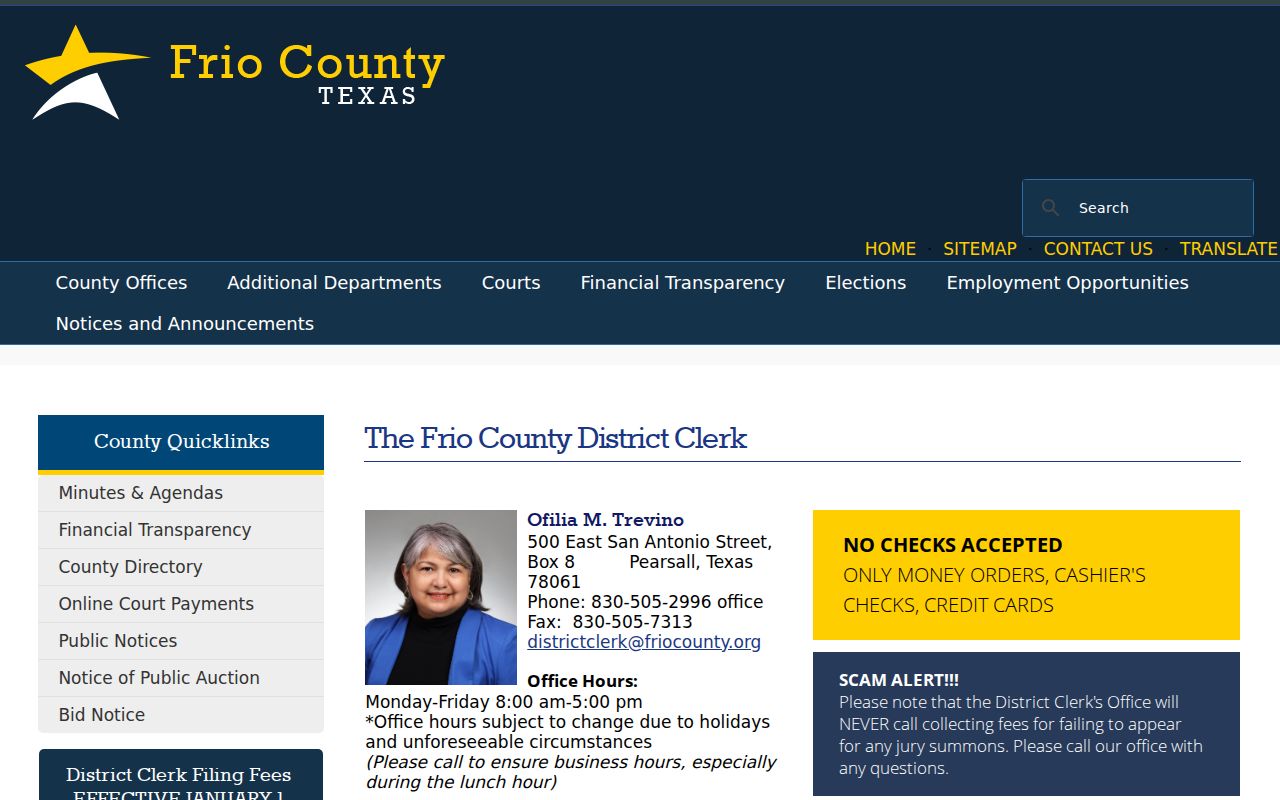
Skip the regional court website for copy questions. The District Clerk's own office answers those, along with status checks on e-filed documents. Its page notes that checks are not accepted and lists money orders, cashier's checks, and credit cards instead.
Frio Court Record Types
A court file can hold a lot. Expect initiating pleadings, indictments, citations, returns of service, motions, notices, orders, judgments, reporter references, exhibits, and proof of service. Contents shift with the case type and access rules. A probate file at the County Clerk looks nothing like a district felony file, and a JP small-claims record never leaves its precinct court.
| Record | Likely custodian | Useful identifier |
|---|---|---|
| District civil or family file | District Clerk | Cause number and document date |
| District felony file | District Clerk | Criminal cause number |
| County Court or probate file | County Clerk | Docket or probate number |
| Small claim or eviction | Proper Justice Court | Precinct and cause number |
| Municipal citation file | Pearsall or Dilley clerk | Citation or case number |
Federal records from Frio County follow a different path: PACER and the Western District of Texas, not a county clerk request.
County Clerk Search Boundaries
County court dockets, probate files, and official public records belong to the Frio County Clerk. The office sits at 500 East San Antonio Street, Box 6, Pearsall, Texas 78061. Call 830-505-2987. Searching takes email or an in-person visit. The clerk needs you identified before running a public-records search. Two things are off limits: phone and fax requests. The office also warns that big search jobs may carry a charge. It will not run lien searches.
The official County Clerk page posts those limits. It also lists the current officeholder and contact details.
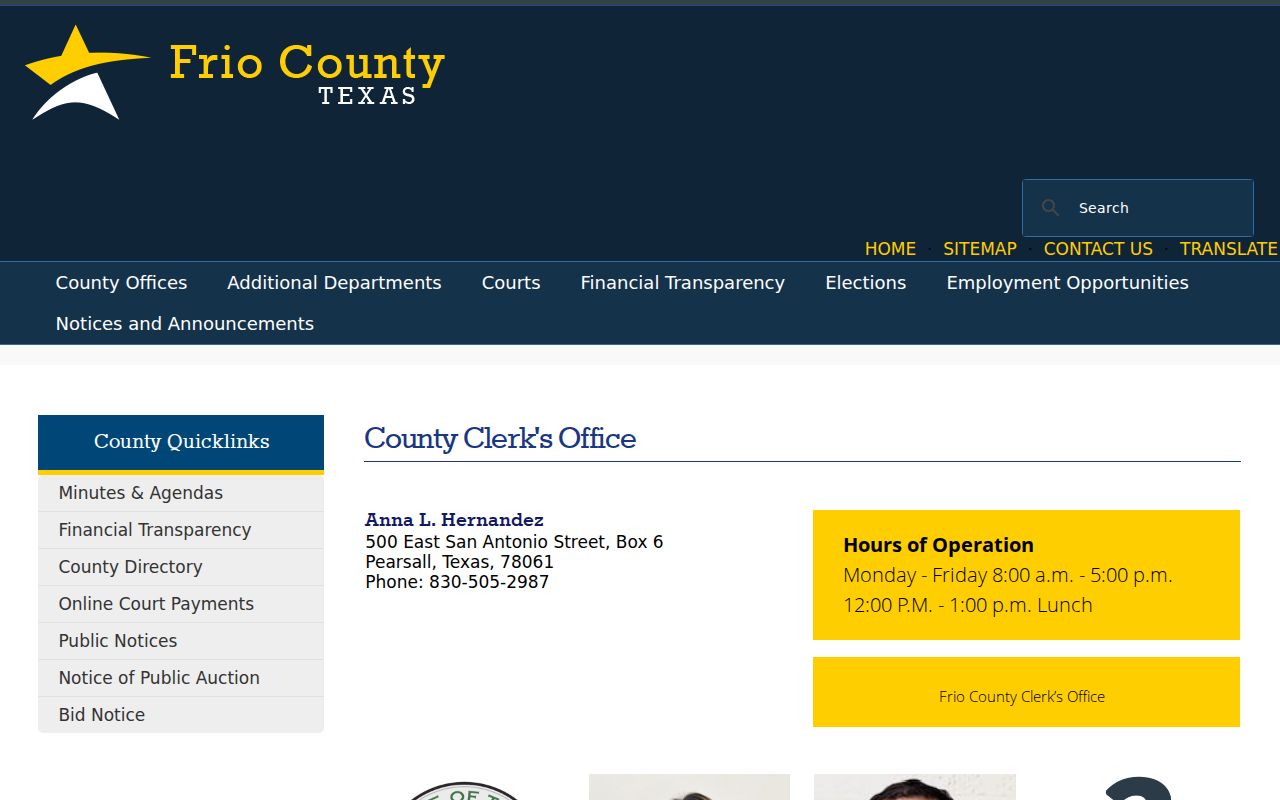
County Clerk name: Official sources do not agree on who currently holds the office. Trust the live county page instead of guessing when the change happened.
Inside a Frio Court Record
The docket hands you the keys to a request, not the full file. Frio district PDFs list a cause number. They also show the case style, setting time, filed date, type, reason, comment, and attorney roles. What they leave out matters. Every linked document, the financial value, and the complete disposition stay off the list. When a signed order and a shorthand scheduling comment conflict, the signed order controls.
| Cause number | The main identifier connecting a docket entry to the clerk file. |
|---|---|
| Filed document | A petition, motion, indictment, order, judgment, or other paper. |
| File stamp | The clerk's receipt information on an accepted filing. |
| Service record | Citation, return, or proof showing service activity. |
| Disposition document | The signed judgment, dismissal, or controlling final order. |
| Certification | The clerk's formal authentication attached to a copy. |
A weekly PDF might read "possible plea," "settlement document pending," or "DWOP." Treat none of those as a final result. Request the later signed document before calling the matter resolved.
Write a Narrow Frio Request
A narrow request saves time and money. Give the full court and the cause number if known. Add the case style, an approximate filing or setting date, and the exact document. State how you want it delivered. Spell out whether you need an electronic image, a plain paper copy, or a certified copy. Add contact information. Ask for a cost estimate up front when the file may run large.
Request formula: Court + cause number + document title or date + plain or certified copy + delivery method.
No single turnaround time covers all Frio County case records. The official sources simply do not promise one. Rule 12's administrative-record timing does not apply to a clerk-held case file. Leave it out of your math. When the cause number is unknown, hand the clerk a narrow date range. Add enough case detail to identify the record.
Fees and Certified Copies
County Clerk pricing splits plain copies from certified ones. The published schedule sets plain copies at $1 per page. Certification adds $5, plus that same $1 per page. Other line items include a $3 file mark, $3 posting, and a $2-per-page fax charge. The District Clerk posts no public copy price. Confirm that cost directly with the office.
| Frio record item | Published amount |
|---|---|
| County Clerk plain copy | $1 per page |
| County Clerk certified copy | $5 certification plus $1 per page |
| JP certified copy | $2 first page; $0.25 each added page |
| JP other copy | $1 first page; $0.25 each added page |
| District Clerk public copy | Confirm with the District Clerk |
Filing fees are a separate animal. A $350 district civil filing base or a $215 county civil petition charge is not what a case-file copy costs.
Plain, Certified, and File-Stamped
A plain copy just reproduces the record. A certified copy adds the clerk's authentication. A receiving court or agency may demand that version. A file-stamped copy proves the clerk or eFileTexas accepted the filing. All three are related, yet none can stand in for another.
| Copy | What it shows | Where to ask |
|---|---|---|
| Plain | Readable reproduction | Record custodian |
| Certified | Clerk authentication | Record custodian |
| File-stamped | Accepted filing mark | Filing account or clerk |
Frio sources publish no general apostille or exemplification workflow. Before ordering, ask the custodian what the intended recipient actually requires.
Public Access and Sealed Records
Access in Texas turns on the record itself. Civil court records carry Rule 76a's open presumption, tempered by sealing and confidentiality law. Juvenile, child-protection, protected-address, expunged, nondisclosed, and sealed material may be withheld or redacted. A blank online result proves nothing. It does not tell you whether a case ever existed.
Governing lines:
Texas judicial records policy distinguishes case records from Rule 12 administrative records.
Texas Rule of Civil Procedure 76a supplies the civil sealing standard.
Family Code Chapter 58 limits juvenile record access.
Sometimes a clerk hands you a copy with details blacked out. That happens when an order or a statute requires it. Ask which law or order the clerk is relying on. The citation should be part of the answer. Whatever you do, do not repost protected details that linger in an older docket image.
Rule 12 and Frio Files
Texas open-government law starts with the Public Information Act, Government Code Chapter 552. Judicial records sit outside that general framework, though, and follow their own boundary. Rule 12 of the Texas judiciary governs administrative records. It does not cover the documents filed in a case. So it will not get you a petition, an indictment, or an exhibit. It will not hand you a judgment from a Frio County case file either. The Texas courts policy draws this line plainly. Case records travel through the clerk, and Rule 12 covers the rest.
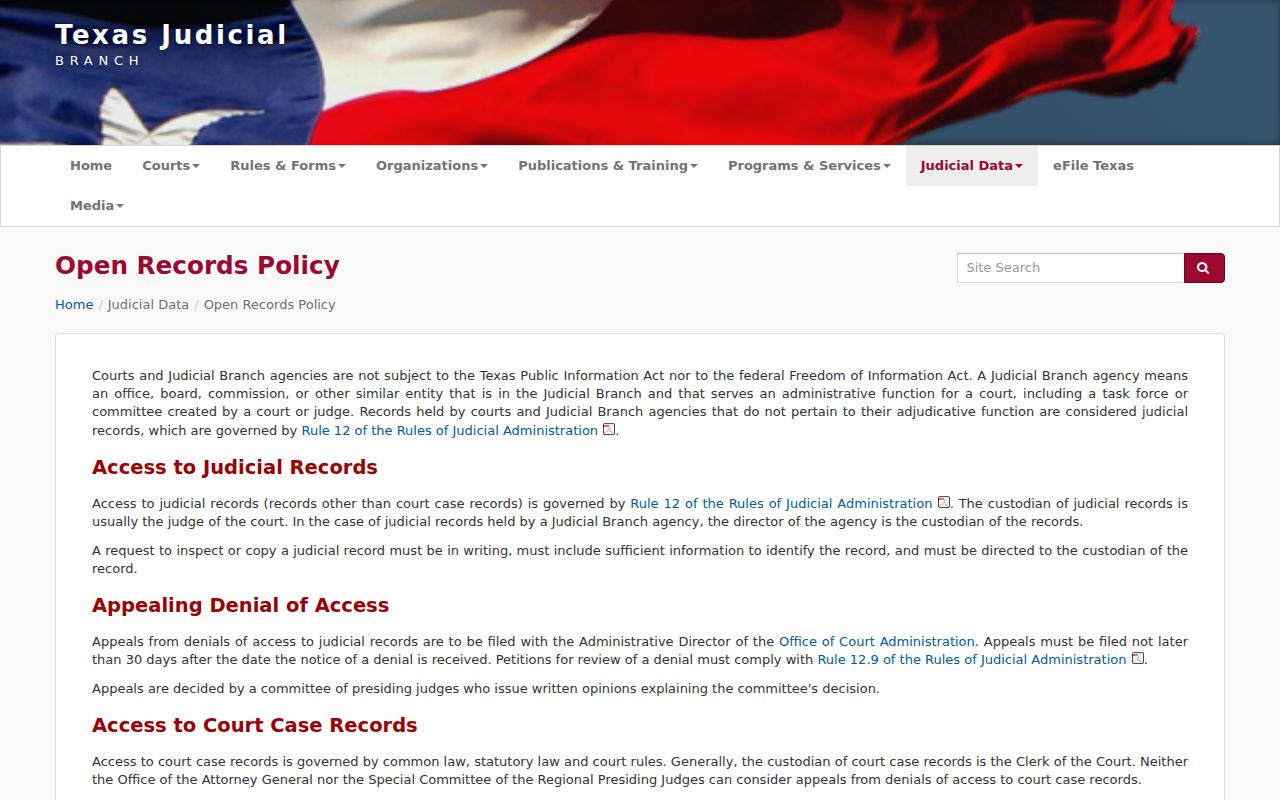
Under that policy, questions about a case file go back to the law and the clerk procedure that govern the case itself. The official Chapter 552 text supplies the wider statutory backdrop.
If a case has been filed, start with the clerk who holds that case file. If you want a judicial administrative record that belongs to no case, a written Rule 12 request is the proper route.